The following miscellaneous items have also been included in this release.
Prior releases of Network Director have included the DCF source for the publications as file 4 (OS) and File 9 (VM). The Page Segments used to include the graphical elements were included as File 5 (OS) or File 9 (VM). BookManager suitable files were delivered as File 10.
With the implementation of the NRS Web Site
(see Publications),
the DCF source code and BookManager formats
are no longer included
on the distribution tape.
If your installation has a requirement for the DCF source or
the BookManager format, please
contact your NRS Representative to arrange for a customized delivery
of the necessary elements.
DOS Installation Library
The distribution library (physical file 10 on the distribution tape) continues to be generated via a LIBR BACKUP function, but has been reorganized for this release of Network Director. The DOS Library now contains the following sublibraries:
Please remember that Network Director is distributed from time to time as a complete replacement VSE Library. Do NOT place any elements into a Network Director Sublibrary that you do not wish to have overlaid.
This release of Network Director supports IBM's Measured Usage License Charges mechanism for measuring the number of Service Units used by Network Director in servicing your users. This support is described in the IBM Publication MVS/ESA Support for Measured Usage License Charges (document number GC28-1098) and requires MVS/ESA 3.1.3 or higher with applicable maintenance applied.
Network Director is normally licensed to a processor based upon Model Group. Some installations may prefer to pay license or maintenance fees based upon the activity levels of Network Director. This is a recognition that Network Director may be used for a small portion of a larger network on a large processor where the full Model Group fee may not be appropriate (i.e. the full Model Group fee does not reasonably reflect the "value received" from running Network Director on the identified processor).
IBM's introduction of MULC is an effort to allow the value of the use of a particular software product follow the actual usage levels of the software instead of simply licensing the product to a given machine's total capacity.
Whether you choose to measure Network Director's consumption or convert an existing license to MULC is a decision that is completely up to each individual installation. The remainder of the description of the MULC in this manual describes only the technical aspects of Network Director's operations. To make use of MULC as a billing mechanism, please contact your NRS Sales Representative for the applicable information and fee schedules.
When this version of Network Director initializes in MVS/ESA systems, it issues the appropriate SVC (IFAUSAGE) to initiate MVS/ESA collection of product based consumption via SMF. [This information is collected into Record Type 89 by SMF and is available for subsequent processing by IFAURP. ] When it initiates (REGISTERs) as a software product, Network Director sets the following MULC operand values:
After the data has been collected you can measure the relative consumption of processor resources by Network Director by executing IFAURP to process the collected SMF records.
Network Director now supports the following variables:
This version of Network Director has reformatted the first line of each output page in the following general format:
where:
Network Director divides all its messages into multiple "classes" of messages called General, Internal, Security, Change, and Response categories. This version of Network Director has added a new class logically between Internal and General called the Debug class. This class (numeric value 90) contains messages that are not of general interest when Network Director is operating normally and are not fully internal in nature.
TND0244 (INQUIRE being issued) and TND0837 (VTAM Return code interpretation) are the first two messages that have been added to this class.
Network Director's operating system console interface for MVS based systems uses SVC 35 to transmit output to the system operator's console.
This release of Network Director now uses the CONSID operand of the newer WTO systems to support extended consoles. The applicable CONSID is extracted from the Communications Input Buffer (CIB) when input is received and used when the resulting output messages are issued from within the LOG processor.
This release of Network Director complies 100% with IBM's published Year2000 initiative. See The Year 2000 and 2-Digit Dates: A Guide for Planning and Implementation (GC28-1251) for additional information.
This version of Network Director has actually added a few Network Director functions to permit installations that have strict Year2000 external requirements to take advantage of improved date handling. See New Variables for specific details about these new functions. comply with requirements that were in place when they were released. Network Director 4.1.0 is Year2000 ready, but NRS recommends updating to 4.2 or later prior to century end.
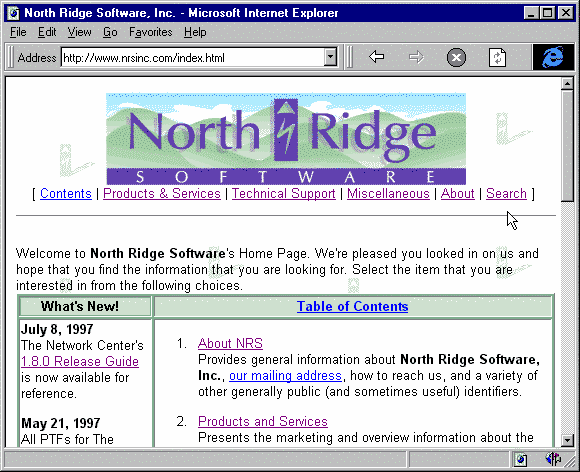
North Ridge Software, Inc. now operates a dedicated Web Server dedicated to supporting NRS licensed locations at WWW.NRSINC.COM. This server is directly connected to the Internet and can be used to improve communications both directions between NRS and NRS licensed locations.
HTTP service is provided from the NRS Home Page at http://www.nrsinc.com/default.asp, which has an appearance similar to:
|
|
Services offered by NRS to its clients associated with this server via the Internet are listed in the following paragraphs.
You can communicate directly with NRS staff by sending mail to:
|
userid@NRSINC.COM
|
Where:
The NRS Mail Server supports all standard SMTP services, including the use of "attached files". If your mail package does not support the use of attached files, consider using FTP services to transfer and receive machine readable copies of files.
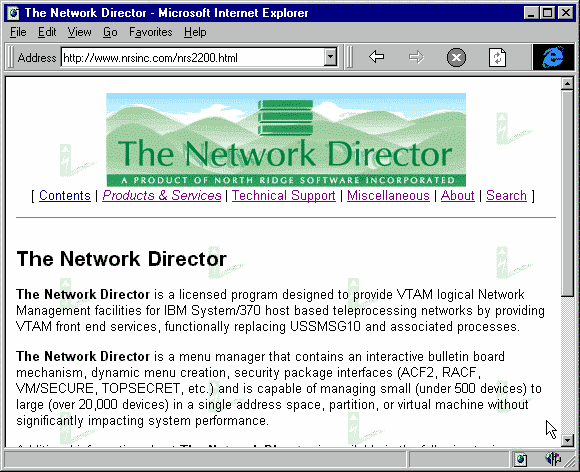
The NRS Web Site contains marketing descriptions of all the NRS product offerings, which can be utilized to orient yourself to any NRS products that you may not be licensed for. This is also useful to use as a reference point for features in the products you may already have licensed.
Many of the "pages" contain conceptual charts and diagrams identifying how a particular NRS products operates, as follows:
|
However, remember that these pages are general in view (that's our definition of "Marketing"). If you are looking for detailed information, see Publications)
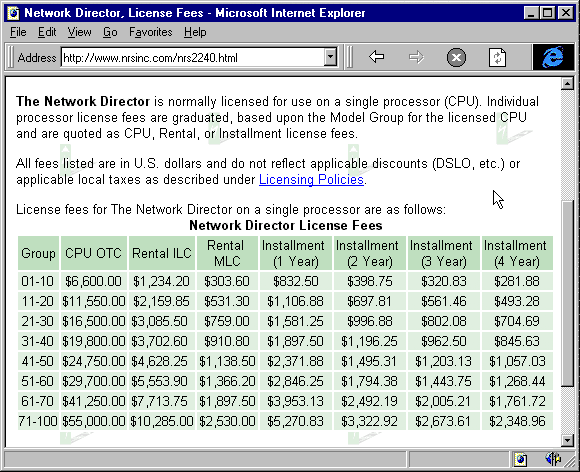
The current NRS License Fee schedules for our products are also available via the Web Site. The license fee schedules not only identify what the fees are associated with acquiring a new license, but also imply the annual maintenance fees
|
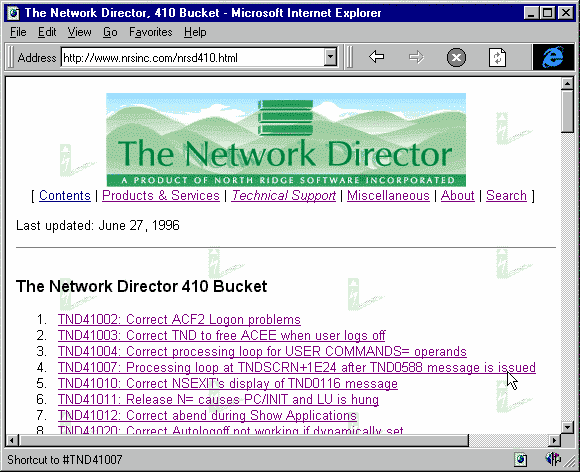
The NRSINC Web Page also contains the text for the current buckets for all supported releases of Network Director and The Network Center available online. You can browse the actual contents of a particular bucket:
|
It is also possible to use FTP (File Transfer Protocol) to obtain a copy of the applicable bucket from the NRSINC system at FTP.NRSINC.COM/NRSINC.
If you find that you have a need to FTP a file to NRS Technical Support, you may send files to FTP.NRSINC.COM/PUBLIC. Please use the applicable NRS APAR number as a portion of the FileName so that NRS can identify what the file relates to. It is also wise to send an Email message to the appropriate individual or function within NRS Technical Support to let them know you have uploaded a file that requires some type of action.
The more recent versions of the NRS product publications have also been converted to HTML for Web browsing. You can see the actual contents of the manuals without ever having the actual hardcopy.
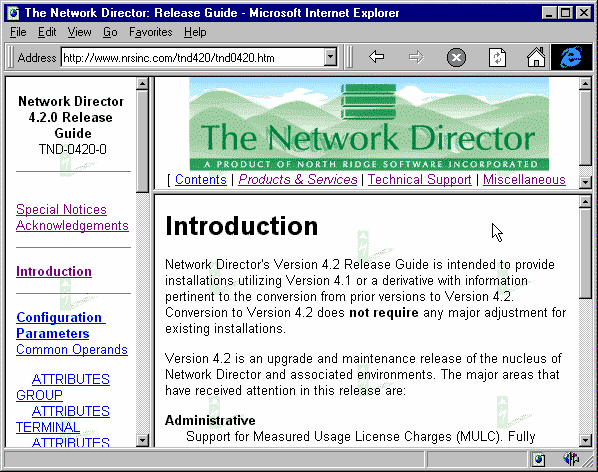
|
These publications are a direct conversion of the DCF source that produces the hardcopy manuals and will replicate exactly what they contain (any errors contained in the hardcopy manuals will be replicated in the Web based versions). Keep in mind we try to update the publications regularly, but the Web based publications are intended to reflect the status of the publications at a specific point in time (watch the publication TNL level to identify a specific level of the publication).